5 Secrets for the Definitive Potato Leek Soup with Chives
Origin and History of Potato Leek Soup with Chives
To understand the soul of potato leek soup with chives, we must travel to the rural gardens of Central France during the coldest years of the European season. The pairing of leek and potato is born from seasonal availability: two humble, robust vegetables capable of surviving the harshest frosts. The direct ancestor of this preparation is Potage Parmentier, named in honor of Antoine-Augustin Parmentier, the 18th-century agronomist and nutritionist who dedicated his life to dispelling the popular fear of the potato.
In pre-revolutionary France, the potato was widely considered a dangerous vegetable, even capable of transmitting diseases. Parmentier needed to change this perception. His strategy was masterful: he convinced King Louis XVI to guard the royal potato fields with armed soldiers during the day and remove them at night. The peasants, convinced they were protecting a royal treasure, stole the tubers under cover of darkness. Unknowingly, Parmentier had turned them into the best ambassadors for the food he wanted to popularize.
Once the potato conquered French tables, its marriage with the leek —a vegetable cultivated since Roman times and present in European gardens for centuries— was natural and immediate. Peasant households would cook both ingredients in water, roughly mash them, and obtain a thick soup that warmed the body after long days working in the fields. It was an unpretentious preparation: only heat, starch, and the subtle sweetness of alliums.
The great leap towards haute cuisine came in 1917 in the kitchens of the Hotel Ritz-Carlton in New York. Chef Louis Diat, remembering the leek and potato soup his mother made in Montmarault, decided to recreate it for luxury diners during an unusually hot summer. He refined it by passing it through a fine sieve, added cream, and served it completely cold, naming it Vichyssoise in honor of the spa town near his hometown.
From peasant potage to an icon of international haute cuisine: that is the journey of potato leek soup with chives. The version we prepare at Cocina Sabroso rescues the best of both traditions: the comforting warmth of the original potage and the technical finesse of haute cuisine straining, crowned with the sharp shower of fresh chives that elevates the dish to another sensory level.
What is Potato Leek Soup with Chives and Why Should You Make It at Home?
Potato leek soup with chives is one of the most noble and technically revealing preparations in spoon cookery. Behind its apparent simplicity lies a rigorous examination of the cook’s skills: controlling the heat to sweat the leek without browning it, managing the potato starch to achieve a silky texture without artificial thickeners, and the precise moment when fresh chives fall onto the hot surface, releasing their essential oils. There are no masks in this dish; every technical decision matters.
Making this soup at home provides a gigantic advantage over any industrial or boxed version: total control over the ingredients. The carefully selected floury potatoes, the fresh leek with its clean, turgid layers, the good quality butter, and the homemade chicken broth make a difference that the palate immediately perceives. The result is a dish of immaculate ivory color, velvety texture, and an aromatic profile that balances the vegetable sweetness of the leek, the starchy neutrality of the potato, the richness of the cream, and the herbaceous freshness of the chives.
This preparation yields six generous servings and can be easily adapted to vegetarian, vegan, or lactose-free diets. It is the perfect starter for an elegant autumn or winter dinner, but also a comforting weekend dish that proves humble ingredients and good technique can go a long way.
In the following sections, you will find the complete list of ingredients with exact quantities, the step-by-step process broken down into five clear steps, the complete nutritional table per serving, and the professional tips that make the difference between an acceptable soup and one your guests will remember fondly.
Ingredients for Potato Leek Soup with Chives
Quantities for 6 servings.
Main Ingredients
- 800 g floury potatoes (Russet or Yukon Gold)
- 500 g leeks — only the white and pale green part
- 1.2 liters white chicken stock or clarified vegetable broth
- 60 g unsalted butter (preferably 82% milk fat)
- 150 ml fresh heavy cream (minimum 35% fat)
Seasonings and Optional
- 1 small bunch fresh chives
- 10 g fine sea salt (to taste, added gradually)
- 2 g freshly ground white pepper
- 1 tiny pinch whole nutmeg for grating
- 15 ml mild extra virgin olive oil (Arbequina type)
How to Make Potato Leek Soup with Chives Step by Step
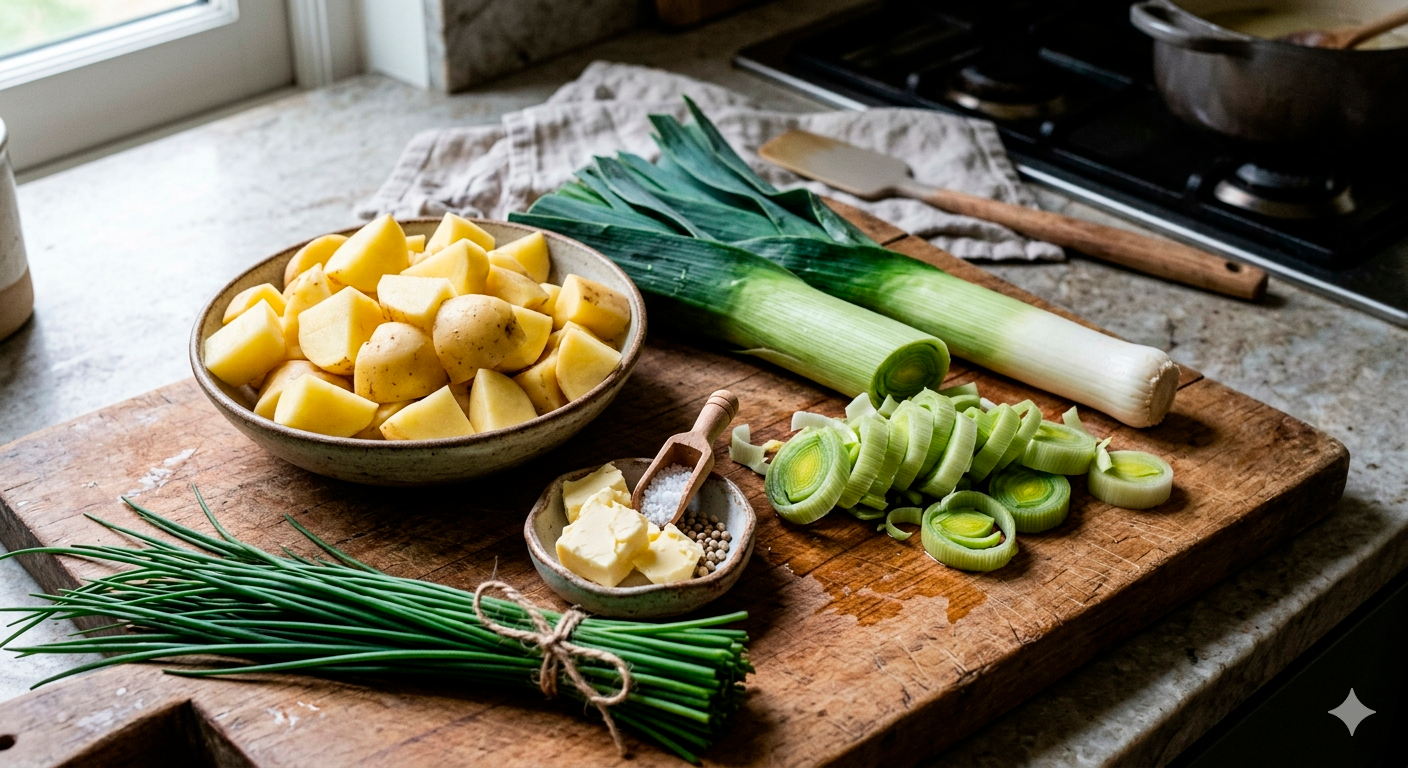
- Step 1 — Thorough washing and precision cutting: The leek accumulates dirt between its concentric layers, so deep cleaning is essential. Make a longitudinal cross cut at the top of the stalk and rinse it under abundant cold running water, opening the layers with your fingers. Once clean, dry it well and cut it into thin slices following the émincé method. For the potatoes, peel them with a peeler to minimize waste and cut them into uniform cubes approximately 2 cm per side. Uniform size ensures even cooking. Do not submerge the potato cubes in water, as you would lose the soluble starch essential for the final consistency.
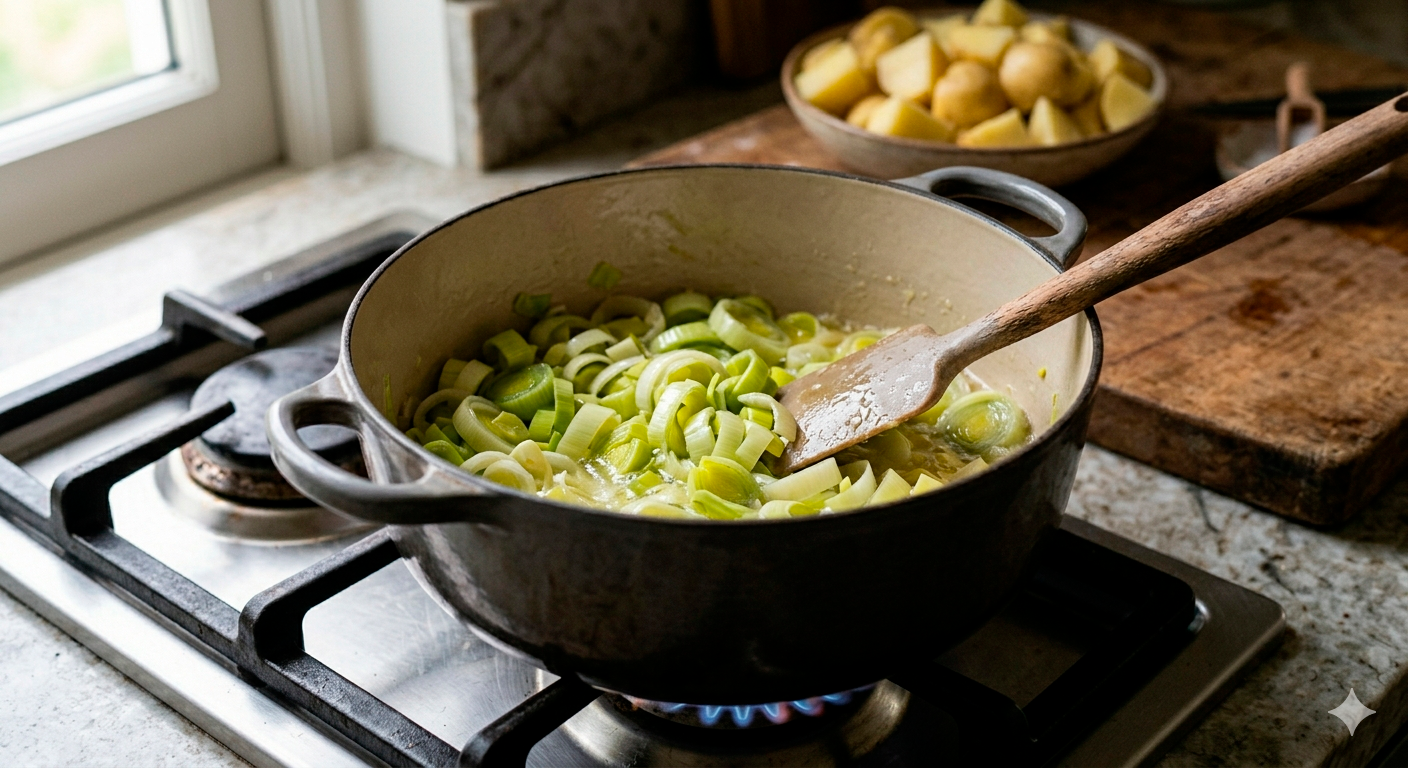
- Step 2 — Aromatic sweating in fat: Place a heavy-bottomed pot over medium-low heat with 60 g of butter and an imperceptible drizzle of olive oil. When the butter stops foaming, add the chopped leek and immediately add a pinch of salt to stimulate osmosis and release the vegetable’s juices. The goal is to achieve the sweating of the leek: it should become translucent, tender, and release its natural sugars in 10 to 12 minutes over low heat, without acquiring the slightest golden color. Caramelization would ruin the soup’s ivory color and introduce unwanted bitter notes. Stir constantly with a silicone spatula.
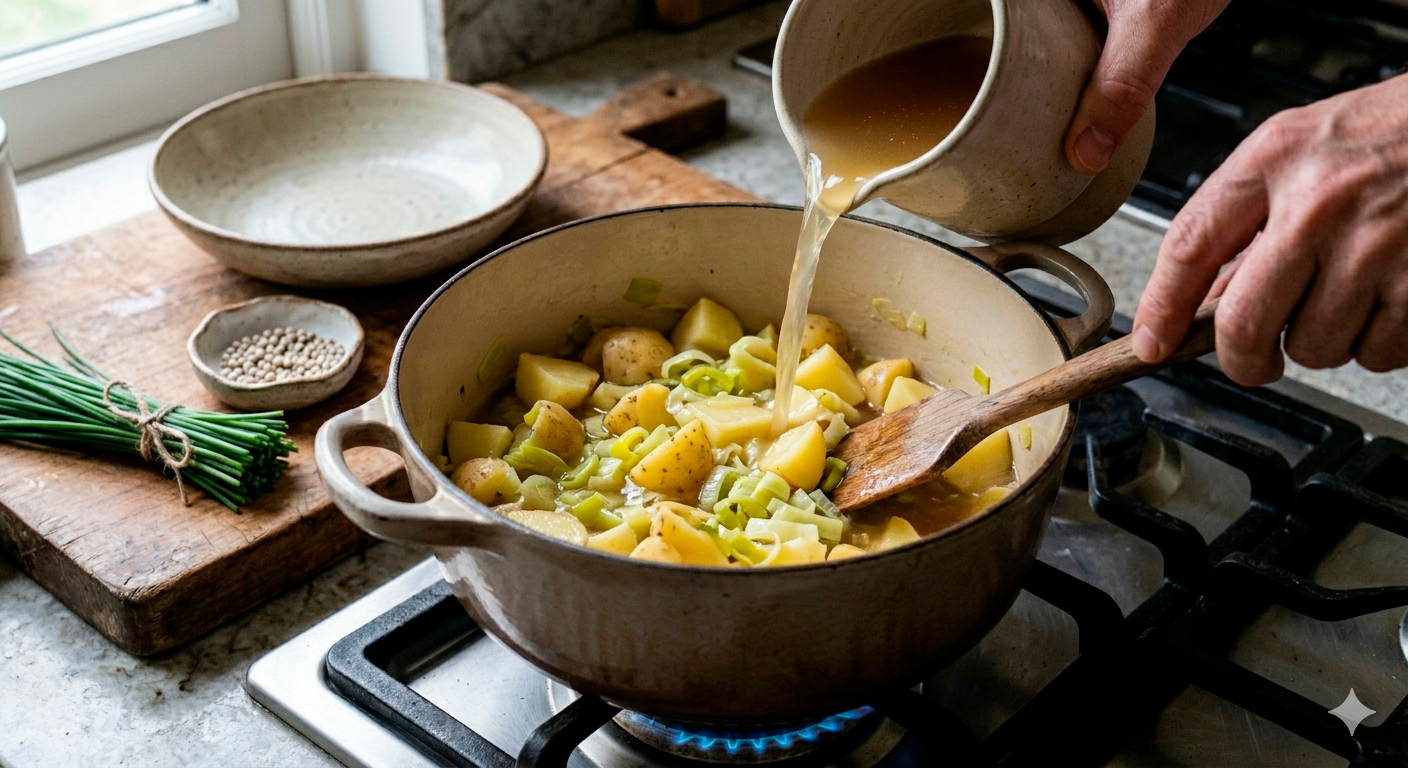
- Step 3 — Base cooking and starch gelatinization: Once the leek is completely tender and gives off a sweet, subtle aroma, add the potato cubes and stir vigorously for 2 minutes to coat them with the flavored butter. Pour in the broth —ideally hot, to avoid interrupting the cooking momentum— until it covers the ingredients by about 2 fingers. Bring to a boil and reduce the heat to minimum. Partially cover to allow controlled evaporation and cook on low heat for 20 to 25 minutes. Check the doneness by piercing a potato cube with the tip of a knife: it should enter and exit with absolute smoothness.
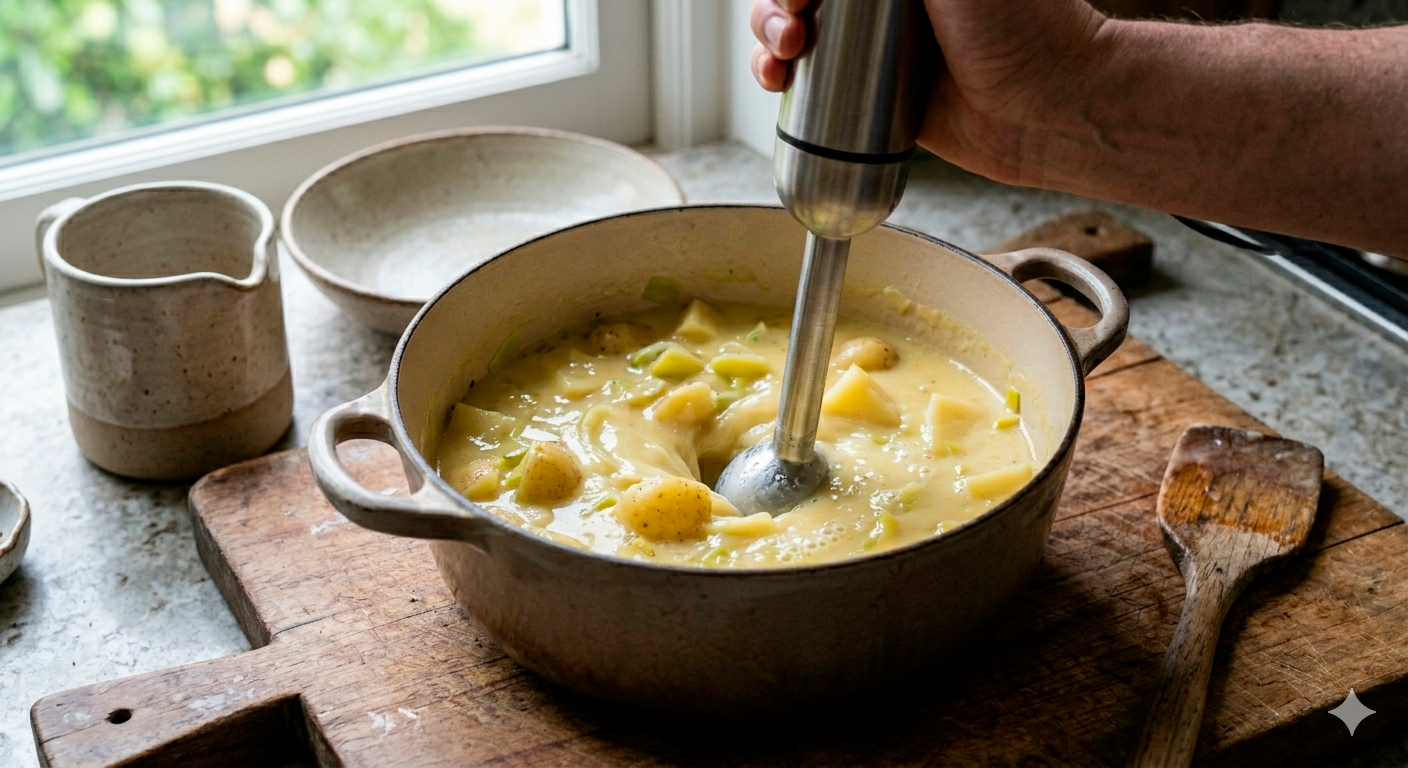
- Step 4 — Texture transformation and straining: Remove the pot from the heat and let rest for 5 minutes to reduce the risk of burns when blending. Process the solids with a portion of the broth in a high-powered blender or with an immersion blender at maximum speed for 2 to 3 continuous minutes, gradually adding the remaining liquid until reaching the perfect nappe consistency — one that coats the back of a spoon without immediately dripping off. For a haute cuisine finish, pass the hot soup through a chinois or fine-mesh strainer, pressing with a ladle to remove any residual leek microfibers.
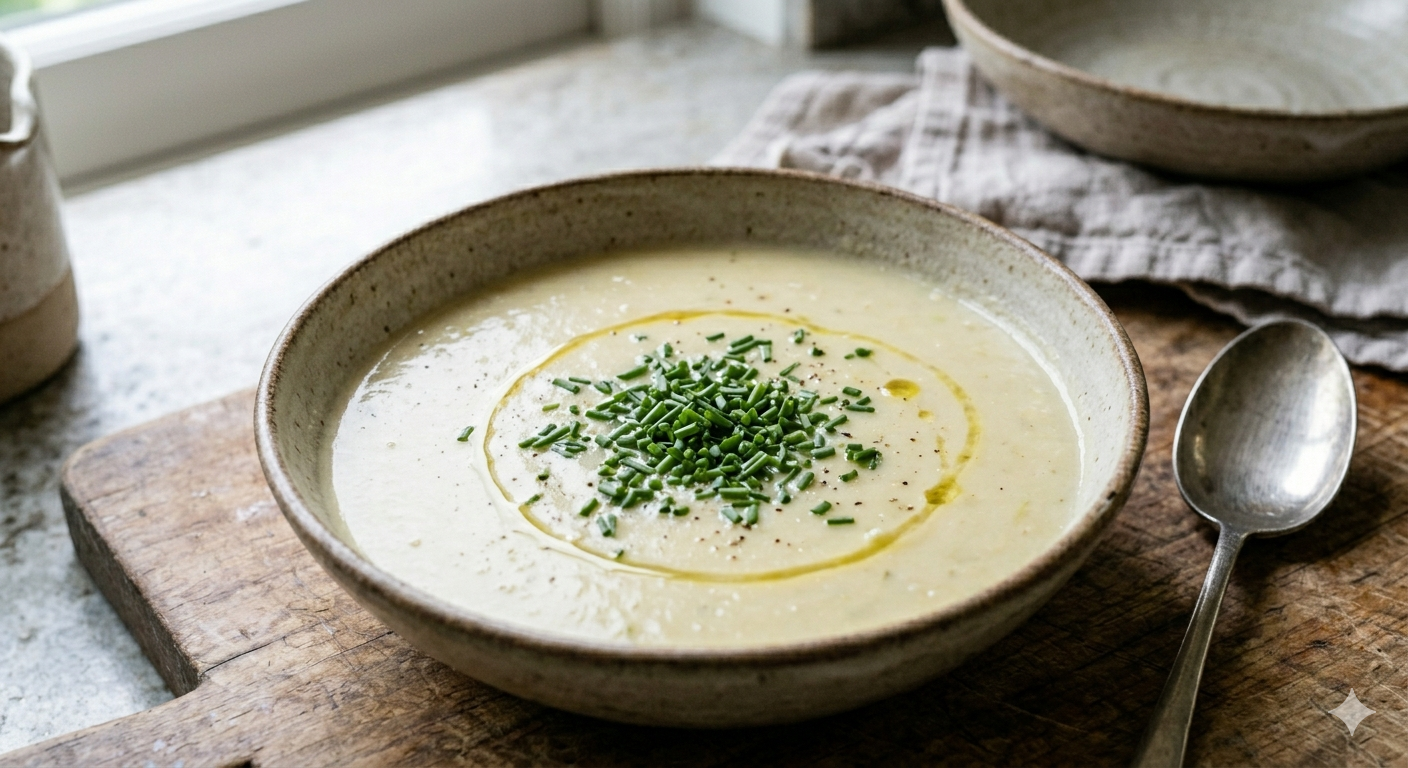
- Step 5 — Thermal finishing and the fresh chive shower: Return the strained soup to a clean pot over very low heat. Incorporate the 150 ml of fresh heavy cream with gentle folding motions until fully combined. Add the freshly ground white pepper and the almost invisible grating of nutmeg. Taste and adjust salt if necessary. Keep at about 75°C, avoiding boiling which would destabilize the dairy fats. Just before serving, finely chop the chives with a very sharp knife. Pour the soup into preheated bowls, draw a spiral of olive oil, and crown with the generous chive shower. Serve immediately.
Nutritional Information for Potato Leek Soup with Chives
Approximate values per serving (6 total servings).
| Nutrient | Per Serving | % Daily Value* |
|---|---|---|
| Calories | 245 kcal | — |
| Protein | 4.5 g | 6% |
| Complex Carbohydrates | 28 g | 9% |
| Total Fat | 12.5 g | 16% |
| Saturated Fat | 7.8 g | 35% |
| Dietary Fiber | 3.2 g | 12% |
| Sodium | 420 mg | 18% |
*Percent based on a 2,000 kcal daily diet.
Expert Analysis: The Master Touch for Potato Leek Soup
From a technical perspective, the success of potato leek soup with chives depends on two simultaneous balances: starch control and preservation of volatile aromatics. The potato acts as a natural binding agent: when cooked, its starch granules absorb water, swell, and upon processing, release that starch which traps the free liquid and dictates the soup’s thickness. No flours or artificial thickeners are needed. However, handling the starch requires care: if processed excessively at low temperature or for too long, the molecules break down and create an elastic, heavy texture similar to paste. That is why it is always processed while the preparation is hot.
The leek, for its part, provides sulfur compounds that during slow sweating transform into complex sugars. This vegetable sweetness is the ideal counterpoint to the starchy neutrality of the potato. The decision to use white pepper instead of black is not a whim: it responds to an aesthetic criterion —eliminating dark specks in a light soup— and an aromatic one, since white pepper offers a more linear warmth that respects the dairy nuances and does not compete with the finesse of the leek.
The final gesture of the chives, far from being merely decorative, is the most intelligent aromatic intervention of the dish. Belonging to the same botanical family of alliums as the leek, chives create a vegetable coherence in the dish. Their essential oils are extremely volatile and sensitive to heat; that is why they must be cut and added at the very last second. When they fall raw onto the hot soup surface, the steam acts as a natural aromatic diffuser, releasing fresh and herbaceous notes that cut through the richness of the dairy fat and cleanse the palate between spoonfuls.
For pairing, this potato leek soup works exceptionally well with white wines of mineral profile and medium acidity: a Chablis Premier Cru, a Galician Albariño, or a Marlborough Sauvignon Blanc are masterful choices. If you prefer a non-alcoholic option, a cold chamomile infusion with a touch of fresh ginger produces a refreshing contrast that enhances the herbaceous notes of the chives. — El Godínez Hambriento, Cocina Sabroso
Tips for Making Perfect Potato Leek Soup
The first professional secret for an irresistible potato leek soup with chives is the selection of raw materials. Look for potatoes classified as floury or mealy —these have a high starch content that allows them to release the correct load during cooking, giving natural body to the soup without thickeners. Avoid waxy potatoes or new potatoes with red or shiny skin: they retain too much moisture and produce a liquid soup lacking unctuousness.
For washing the leek, if you detect very compacted dirt, cut it into slices first and submerge them in a large bowl of cold water, moving them with your hands. The dirt will sink to the bottom due to its weight, and you can remove the floating slices with a skimmer, clean and ready. This method is much more efficient than rinsing under the tap for very dirty leeks.
Avoid highly processed industrial bouillon cubes. They contain excess monosodium glutamate and added salt that mask the delicate flavor of the leek, delivering a soup with a chemical, uniform profile. A homemade stock made from chicken carcasses, onion, carrot, and celery makes an abysmal difference in the final result. If you don’t have homemade broth, use a low-sodium boxed broth.
If the soup has turned out thicker than desired —because the potatoes had more starch than expected— do not dilute it with water. Use small splashes of warm whole milk or remaining broth, incorporating them little by little over low heat while whisking with a balloon whisk. This maintains the homogeneity of the emulsion without breaking it. And if you accidentally oversalted, introduce raw potato slices into the soup for 10 minutes over very low heat: they will act as a sponge and absorb part of the sodium without altering the texture.
Chives should never be chopped in advance. When cut, their cell walls break and the essential oils begin to oxidize immediately, transforming the fresh perfume into a rancid smell reminiscent of old onion. Chop them literally over the dish the instant before serving. An extremely sharp knife is essential: a dull blade crushes the herb instead of cutting it, accelerating the loss of aromas.
Variations and Substitutions for Potato Leek Soup with Chives
The technical base of potato leek soup is so versatile that it admits multiple interpretations without losing its essence. The vegan and dairy-free version substitutes butter with mild olive oil and heavy cream with unsweetened almond cream, culinary coconut cream, or cashews activated in hot water and processed. The chicken broth is replaced with a vegetable stock enriched with dried shiitake mushrooms to add umami depth.
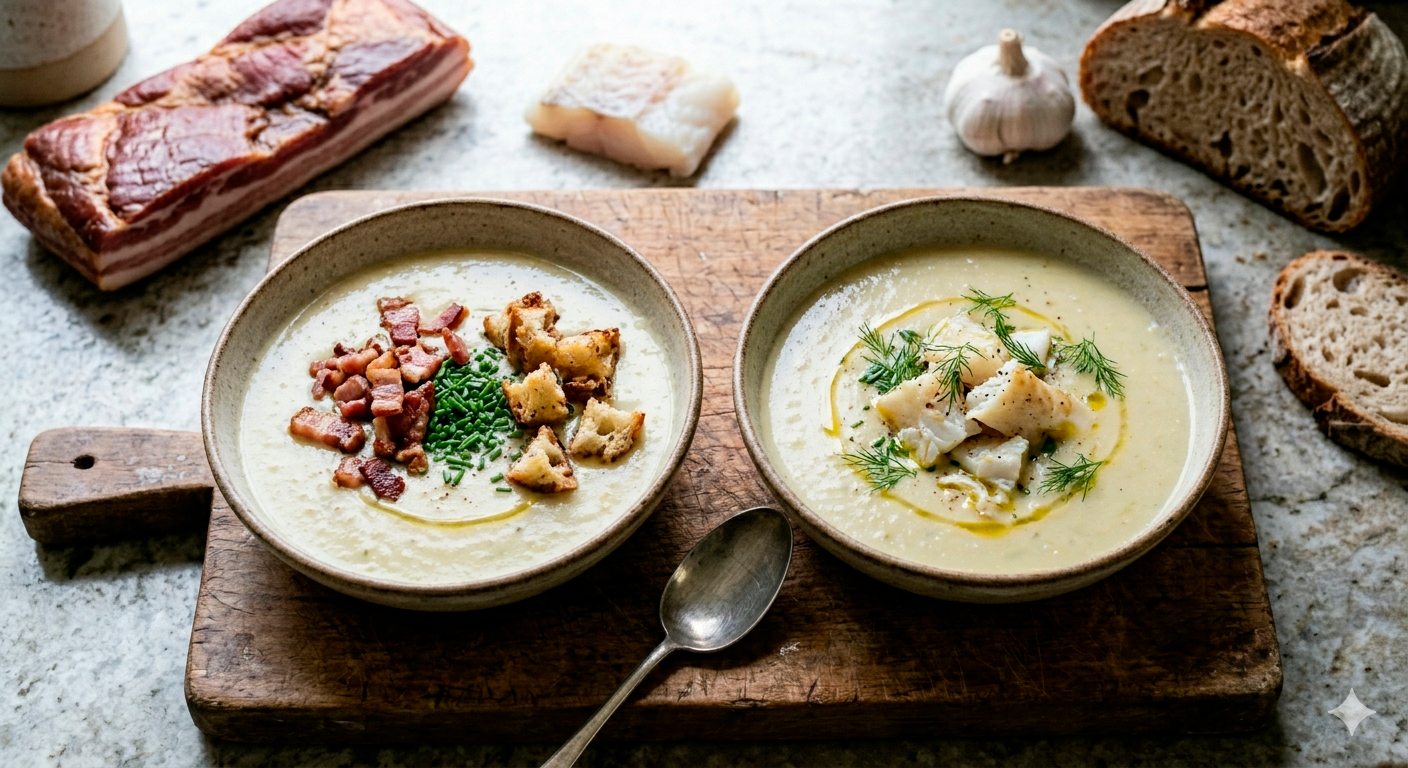
The rustic mountain version omits completely peeling the potatoes and keeps the thin skin, incorporates the intermediate green part of the leek for a heartier flavor, and finishes with a manual masher instead of a blender, leaving visible chunks. It is crowned with crispy smoked bacon bits and garlic-rubbed crusty bread croutons. The seafood variation turns this soup into a haute cuisine first course using fish fumet as a base and adding in the last minutes cubes of desalted cod, prawns, or seared scallops.
Frequently Asked Questions about Potato Leek Soup with Chives
Can you freeze potato leek soup with chives?
You can freeze it, but with an important technical condition: do it before adding the fresh heavy cream. Potato starch undergoes retrogradation when frozen, and dairy fats separate, resulting in a gritty, broken outcome. Thaw slowly in the refrigerator for 24 hours, heat in a pot, and process again with an immersion blender to recover the texture. Add the fresh heavy cream after thawing and just before serving.
How long does potato leek soup last in the refrigerator?
Properly stored in an airtight glass container, it lasts 3 to 4 days in the refrigerator. It is essential to transfer it to the container within 2 hours of preparation, as the range between 5°C and 60°C is the danger zone where bacteria multiply rapidly. If you notice a sour smell or excessive phase separation, discard it.
How many calories are in potato leek soup?
Each standard serving provides approximately 245 kcal, with 28 g of complex carbohydrates, 4.5 g of protein, and 12.5 g of fat. It is a dish of moderate caloric density with high satiating power thanks to the soluble fiber of the leek and potato, ideal as a starter or comforting dinner without excess calories.
Can you make potato leek soup without heavy cream?
Yes. Heavy cream can be substituted with unsweetened almond cream or culinary coconut cream in the same proportion. Also, processing a handful of cashews activated in hot water for 2 hours and adding them during blending works very well; the result is equally creamy with a slightly sweeter and more exotic flavor profile. For the lightest version, simply omit the cream and use a bit more broth to adjust the consistency.
How is potato leek soup with chives best served?
The optimal way is in preheated deep bowls at about 75°C, with a drizzle of Arbequina extra virgin olive oil drawn in a spiral over the surface and a generous shower of fresh chives cut at the very last moment. Accompany with slices of garlic-rubbed rustic toasted bread or baguette croutons. For a refined Vichyssoise-style version, serve completely cold in summer, slightly intensifying the seasonings during cooking to compensate for the lower thermal sensitivity of the taste buds.
Reference Resources and Links
For more information on food safety and nutrition, consult the WHO healthy diet guidelines.
Regarding the nutritional value of ingredients, you can consult The Nutrition Source of the Harvard T.H. Chan School of Public Health.
Information on food composition available from the database of the Mexican National Institute of Public Health.
Consult our disclaimer and legal notice policy before making dietary decisions based on this content.