Roasted Tomato and Fresh Basil Irresistible Soup: Homemade Recipe in 5 Steps
5 Steps to prepare the most irresistible roasted tomato and fresh basil soup of your life
Origin and History of Roasted Tomato and Fresh Basil Soup
To understand why roasted tomato and fresh basil irresistible soup has become one of the most prepared dishes in kitchens around the world, it is necessary to take a journey to its roots. The tomato —or jitomate, as it is known in Mexico— is a gift that America offered to the rest of the planet. Spanish conquistadors introduced it to Europe during the 16th century, but its reception was rather cold: in countries like Italy, France, and England, it was considered an ornamental plant of dubious reputation, and was even attributed poisonous properties for belonging to the nightshade family.
It was not until the 18th century when southern Italy, and particularly the Campania region, conclusively debunked this myth. Neapolitan peasants began incorporating tomatoes massively into their daily diet, discovering that fruits ripened under the Mediterranean sun reached extraordinary levels of sweetness and acidity. It was in those same orchards where the combination of tomato and basil was born: a pair born of necessity and consecrated by time, where the aniseed and minty notes of the herb perfectly balanced the vibrant acidity of the fruit.
With the great migratory waves that took thousands of Italian families to North America between the end of the 19th century and the beginning of the 20th, these culinary traditions crossed the Atlantic. Recipes were adapted to locally available ingredients, merging with the Anglo-Saxon tradition of creamy and comforting soups. The result was a more sumptuous, velvety, and nuanced preparation. What began as a rustic farmer’s broth in the fields of Naples evolved into the sophisticated soup we enjoy today worldwide.
The roasting technique, fundamental to this recipe, is not new. Mesoamerican civilizations already subjected jitomate to dry heat on griddles and coals to make sauces and base preparations. Mexican cuisine has roasted tomato as one of its deepest foundations: the molcajete with burnt tomato, onion, and roasted garlic is an image that no Mexican cook can ignore. This recipe for roasted tomato and fresh basil irresistible soup is, in essence, the perfect meeting of two great traditions: the Mediterranean, which contributes basil and the smoothness of olive oil, and the Mexican, which contributes the memory of roasting and the love for deep, concentrated flavors.
What is Roasted Tomato and Fresh Basil Soup and why should you make it at home?
Roasted tomato and fresh basil irresistible soup is much more than a simple hot vegetable puree. It is a preparation that transforms humble ingredients —ripe tomatoes, onion, garlic, olive oil, and fresh herbs— into a complete sensory experience that embraces the soul with every spoonful. Unlike commercial canned or powdered versions, this homemade recipe uses the roasting technique in the oven to concentrate the natural sugars of the tomato, generating a deep, sweet, smoky, and perfectly balanced flavor profile that no industrial production can replicate.
The secret lies in the process. When tomatoes are subjected to dry, intense heat at 200°C, their internal water partially evaporates, their sugars caramelize, and the skin acquires small dark spots that, far from being a defect, are the source of an incredibly complex smoky nuance. The onion becomes sweet and translucent; the garlic transforms into a soft, aromatic paste without the aggressive bite of raw garlic. This concentration of flavors is the abysmal difference between an ordinary soup and a truly irresistible roasted tomato and fresh basil soup.
Making it at home has advantages that go beyond flavor. You control exactly what ingredients go into the pot: no preservatives, no excessive sodium, no artificial flavor enhancers. You choose the quality of the olive oil, the freshness of the basil, the ripeness of the tomatoes. The result is a dense, silky soup, a deep red color, and an aroma that fills the entire kitchen from the moment you open the oven. That aroma, precisely, is one of the most honest pleasures in the culinary world.
This roasted tomato and fresh basil soup recipe is also an extraordinarily versatile dish. It works as an elegant starter for a dinner among friends, as a light and nutritious lunch on a workday, as a comforting dinner on rainy winter nights, or even as a base for sauces, risottos, and pasta. Its yield of 6 servings makes it an ideal preparation for cooking in quantity and storing during the week, since, like any good stew, its flavors mature and deepen with the passage of hours in the refrigerator.
From a nutritional standpoint, this roasted tomato and fresh basil irresistible soup is an ally for health. Each serving provides only 185 kcal with an outstanding nutritional profile: vitamin C (46% of the recommended daily value), vitamin A (36%), dietary fiber (12%), and a generous dose of lycopene —the powerful antioxidant of tomato— whose bioavailability is multiplied precisely when the fruit is cooked and combined with a healthy fat like olive oil. It is a dish that cares for the body while comforting the spirit.
Ingredients for Roasted Tomato and Fresh Basil Soup
Quantities for 6 servings.
Main Ingredients
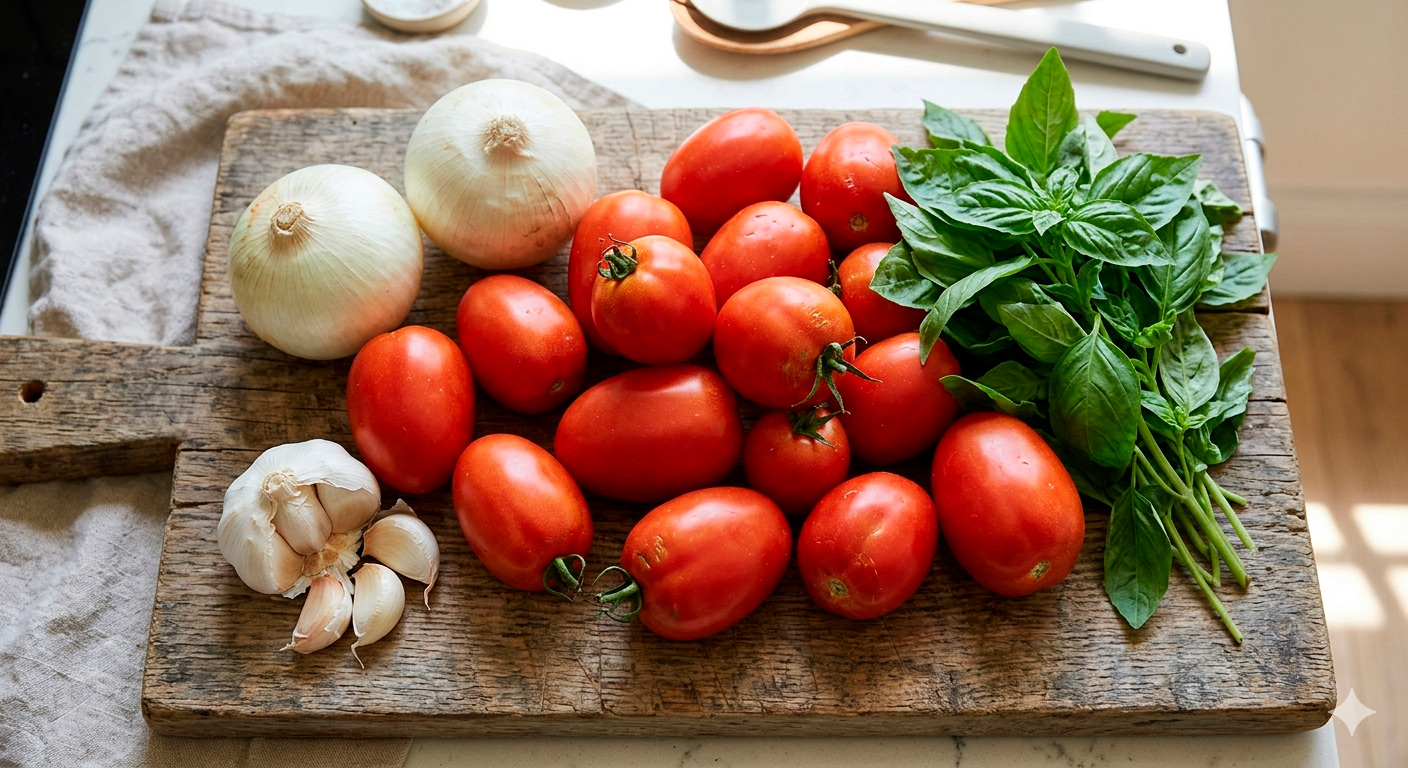
- 1.5 kg ripe Roma or Pera tomatoes (jitomate), cut in half
- 2 medium white onions, cut into thick quarters
- 6 large cloves of garlic, peeled and whole
- 60 ml extra virgin olive oil
- 750 ml homemade vegetable broth, hot
Seasonings and Optional
- 1 cup fresh Genovese basil leaves, firm
- Freshly ground black pepper, to taste
- Fine sea salt, to taste
- 1 teaspoon brown sugar (optional, acidity corrector)
- 50 ml heavy cream (optional, for velvety finish)
How to make Roasted Tomato and Fresh Basil Soup step by step
- Select, wash and cut the vegetables: Wash all the tomatoes and basil leaves thoroughly under cold running water. Dry the tomatoes with a clean cloth to prevent excess moisture from interfering with the caramelization process. With a sharp knife, remove the stem from each tomato and cut them in half lengthwise. Peel the onions and cut them into thick quarters. Peel the garlic cloves and keep them whole, without chopping, to prevent them from burning during roasting.
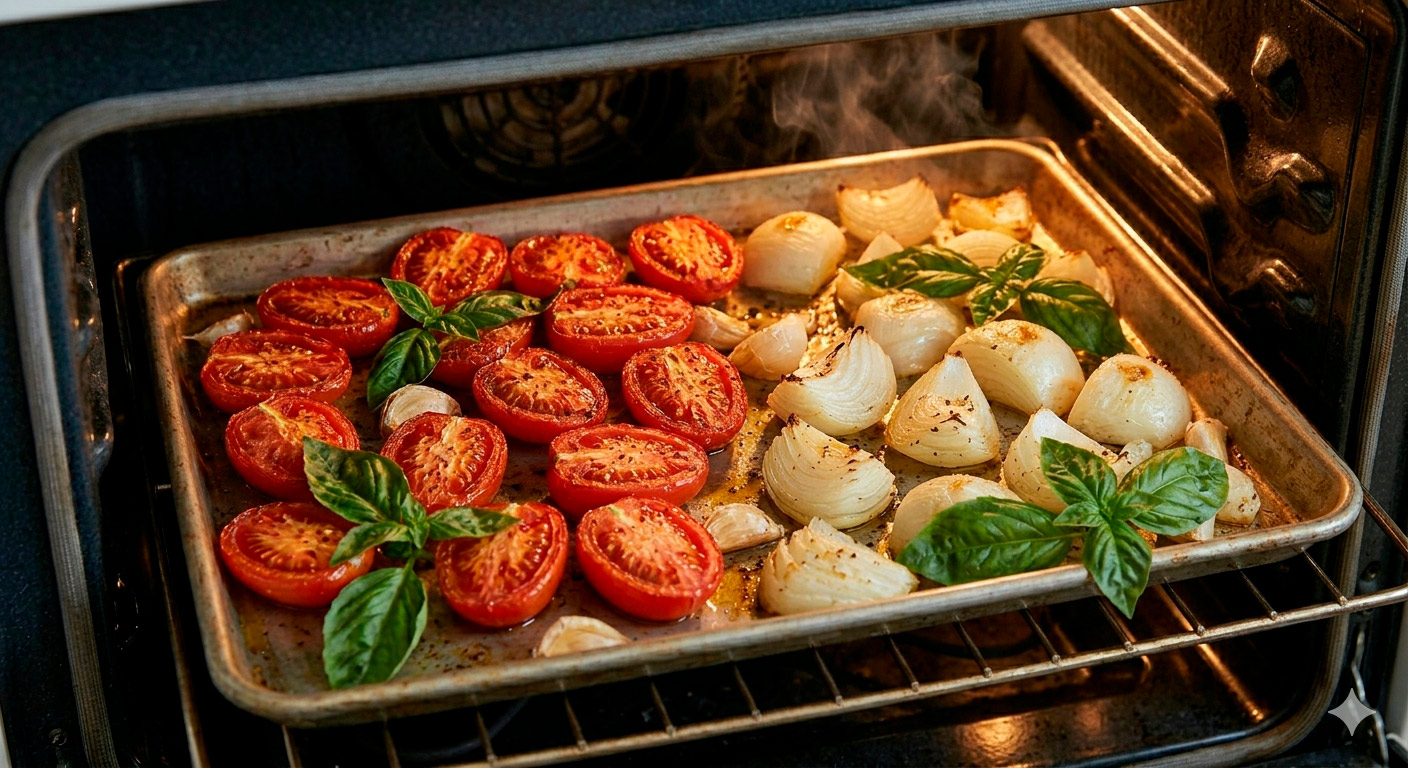
- Arrange on baking sheet and season before the oven: Preheat the oven to 200°C (392°F). On a large baking sheet, distribute the tomatoes with the cut side up and intersperse the onion quarters and garlic cloves in the empty spaces. Drizzle the 60 ml of extra virgin olive oil evenly over all the ingredients. Sprinkle sea salt and freshly ground black pepper generously. If the tomatoes are not at their peak ripeness, add the teaspoon of brown sugar at this point.
- Roast the vegetables to concentrate the flavors: Place the baking sheet on the upper third of the oven and bake for 35 to 40 minutes. Monitor the process: success lies in those slightly charred and wrinkled areas of the tomato skin, indicating that the sugars have caramelized successfully. The onion should look translucent with golden edges, and the garlic should be completely tender and soft to the touch. Remove from the oven and let cool for 5 minutes before continuing.
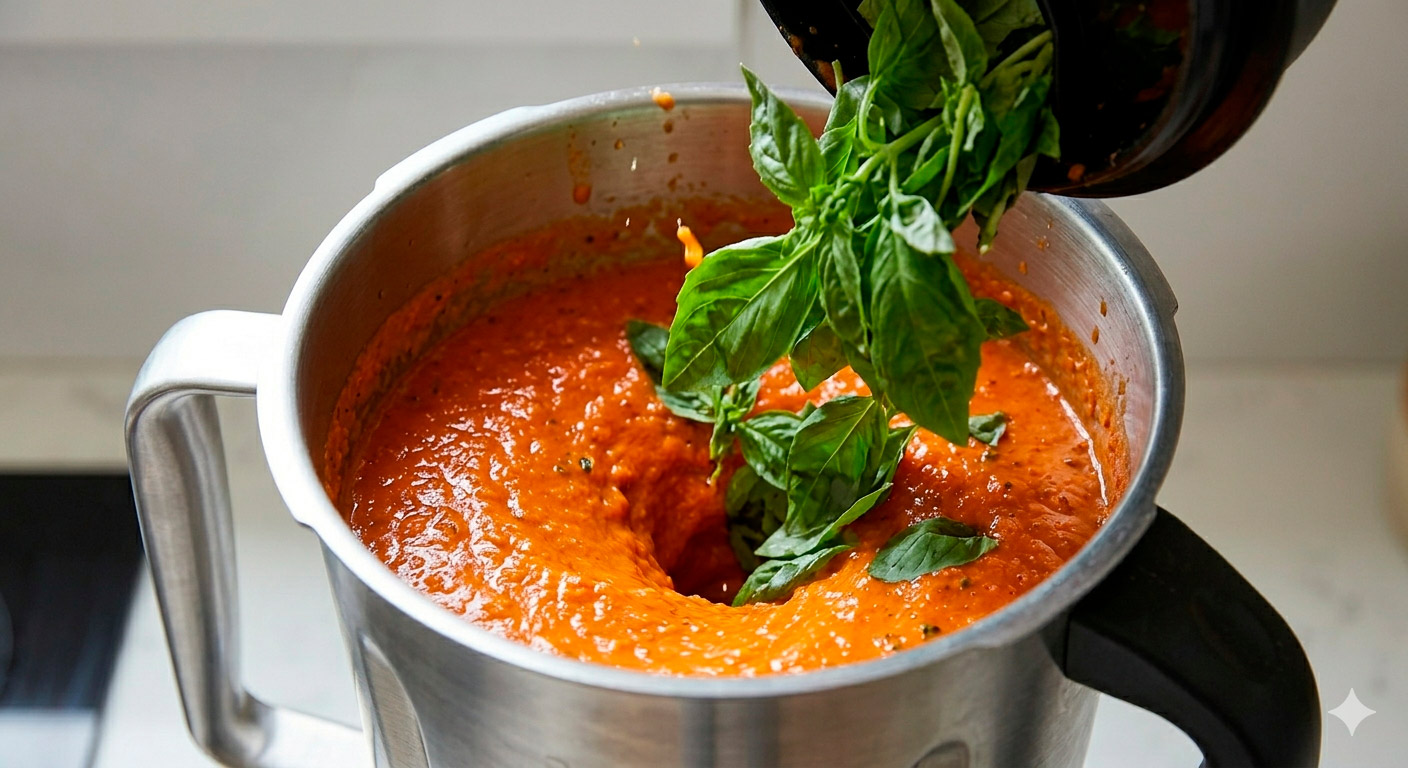
- Blend and incorporate fresh basil: Carefully transfer all the roasted vegetables, along with the natural juices trapped at the bottom of the pan, to a high-powered blender jar. Add the hot vegetable broth and the full cup of fresh basil leaves. It is vital to add the basil at this precise moment: the residual heat of the blended mixture is enough to wilt it gently and release its essential oils without burning it, preserving its vibrant green color and herbal aroma. Process for 60 seconds at maximum power until completely smooth and silky.
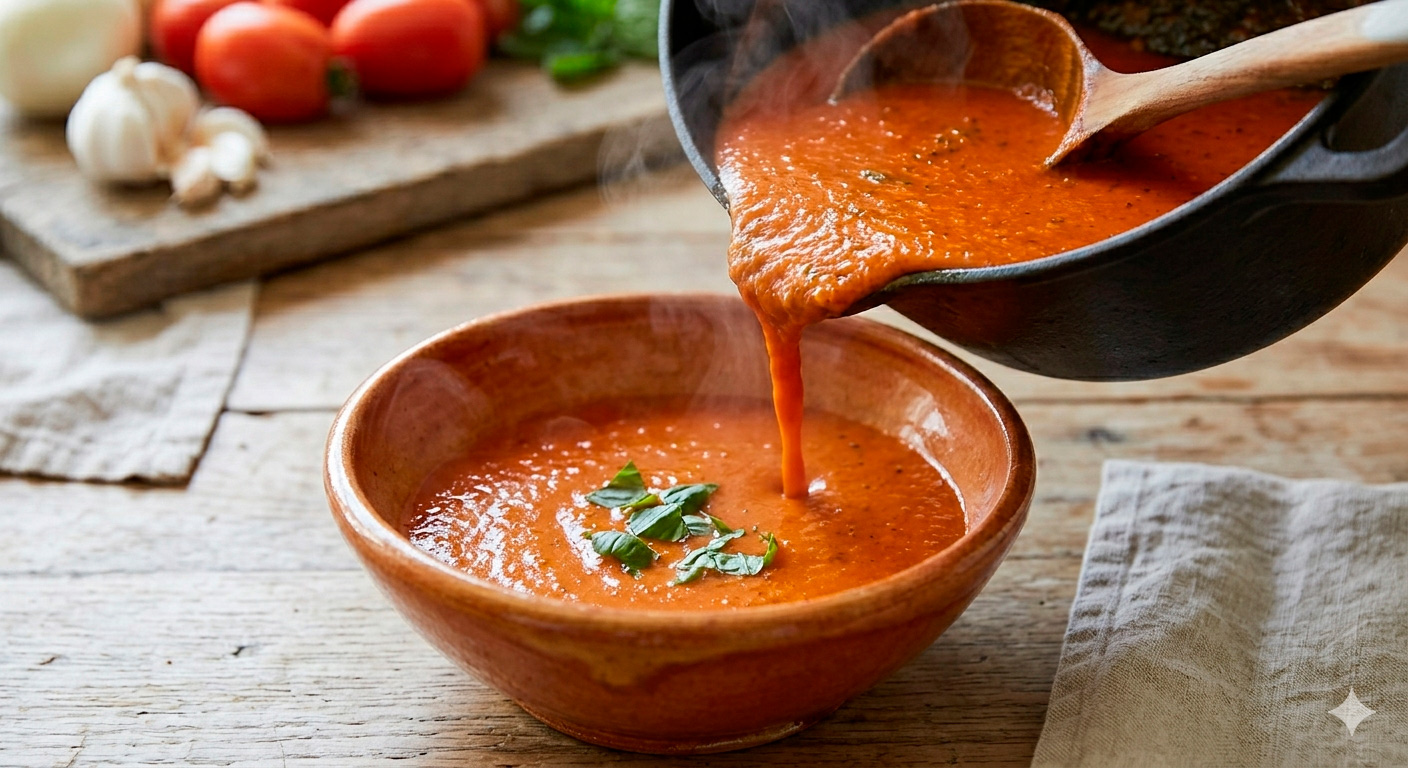
- Strain, reduce and serve: Pour the homogenized soup into a clean pot over medium-low heat. For a high-cuisine worthy texture, pass it through a fine-mesh strainer to remove residual seeds and undissolved skin fragments. Cook over low heat for 10 additional minutes to allow the flavors to blend. In the last minute, if you desire a more sumptuous version, incorporate the heavy cream in a thin stream while stirring constantly. Adjust salt, serve immediately, and garnish with fresh basil leaves.
Nutritional Information of Roasted Tomato and Fresh Basil Soup
Approximate values per serving (6 total servings).
| Nutrient | Per serving | % Daily Value* |
|---|---|---|
| Calories | 185 kcal | — |
| Protein | 3 g | 6% |
| Total Carbohydrates | 14 g | 5% |
| Total Fat | 7 g | 9% |
| Saturated Fat | 1.5 g | 7% |
| Dietary Fiber | 3.5 g | 12% |
| Sugars | 8 g | — |
| Sodium | 420 mg | 18% |
| Cholesterol | 4 mg | 1% |
| Vitamin A | 1800 IU | 36% |
| Vitamin C | 28 mg | 46% |
| Calcium | 45 mg | 4% |
| Iron | 1.2 mg | 7% |
*Percentages based on a 2,000 kcal daily diet.
Expert Analysis: The Master Touch for Irresistible Roasted Tomato and Fresh Basil Soup
From a purely gastronomic and molecular perspective, the success of this roasted tomato and fresh basil irresistible soup lies in the physical-chemical transformation that the ingredients undergo under the dry heat of the oven. The tomato contains high levels of citric acid and malic acid, responsible for that characteristic vibrancy of the fresh fruit. A soup made only with boiled tomatoes will result in a sharp and flat taste on the palate: moist heat extracts the acids without neutralizing or complexing them.
Roasting changes the rules of the game completely. By subjecting the tomatoes to dry heat at 200°C, we activate two simultaneous reactions of great culinary relevance. The first is the Maillard reaction on the exposed surfaces of the onion and garlic, which generates new, highly complex aromatic compounds: notes of nuts, caramel, and a slightly smoky undertone. The second is the caramelization of fructose and glucose present in the tomato pulp, which softens the perception of acidity and adds a deep natural sweetness that no added sugar can imitate with the same elegance.
Basil, for its part, contributes an aromatic layer of extraordinary complexity. Its most important essential oils —linalool, eugenol (also present in clove), and estragole— are highly volatile. If baked along with the tomatoes, the extreme heat will destroy them, leaving a bitter, dark herb. By adding it at the time of blending, the residual heat of the vegetables fresh from the oven is exactly enough to wilt it, release its oils, and preserve its vibrant green color without burning it. This seemingly minor detail is the difference between a good soup and a truly irresistible soup.
Regarding pairing, this tomato soup dialogues impeccably with white wines of medium-high acidity and herbal notes: a Vermentino from Sardinia, a Galician Albariño, or a Sauvignon Blanc from the Casablanca Valley are successful choices. For those who prefer non-alcoholic beverages, sparkling mineral water, a few drops of lemon, and a few fresh mint leaves create a refreshing pairing that enhances the vegetable nuances of the soup. — El Godínez Hambriento, cocinasabroso.com
Tips for preparing the perfect Roasted Tomato and Fresh Basil Soup
The first professional tip I can give you is not to completely remove the slightly burnt skins before blending. Those small dark spots that form on the tomato skin during roasting are, in gastronomic terms, pure gold: blending part of them along with the rest of the vegetables will give the soup an incredibly complex smoky nuance and a deep color that will distinguish this preparation from any commercial version. It is not carelessness; it is conscious technique.
Always use homemade broth, never dehydrated cubes. Industrial broths contain an excessive amount of salt and artificial flavor enhancers —mainly monosodium glutamate— that mask the finesse of the roasted tomato. A quick broth made with carrot trimmings, celery stalk, half an onion, a few garlic cloves, and a parsley stem cooked for 30 minutes will make an abysmal difference in the final result. If you are short on time, an acceptable option is water with a tablespoon of dissolved white miso paste, which will provide body and umami without saturating the sodium.
To achieve the silkiest texture possible, process the soup in two phases. First, blend at maximum power for a full 60 seconds without pausing. Second, pass the soup through a fine-mesh strainer or a chinois, pressing with the back of a spoon to extract all the liquid and leave behind seeds and skin fragments. This additional step, which many omit out of laziness, is what transforms a homemade soup into a restaurant-level preparation.
Regarding the most common mistakes: the first is baking at insufficient temperature. If the oven does not reach 200°C, the tomatoes will cook in their own juice instead of caramelizing, and the result will be a watery, depthless soup. The second mistake is adding the basil too soon: never bake it with the vegetables nor add it to the pot during the final cooking. The third is not drying the tomatoes before baking: surface water creates steam and blocks caramelization. And the fourth, very common, is not adjusting the salt at the end: the broth, reduction, and addition of cream can alter the salt level, so always taste before serving.
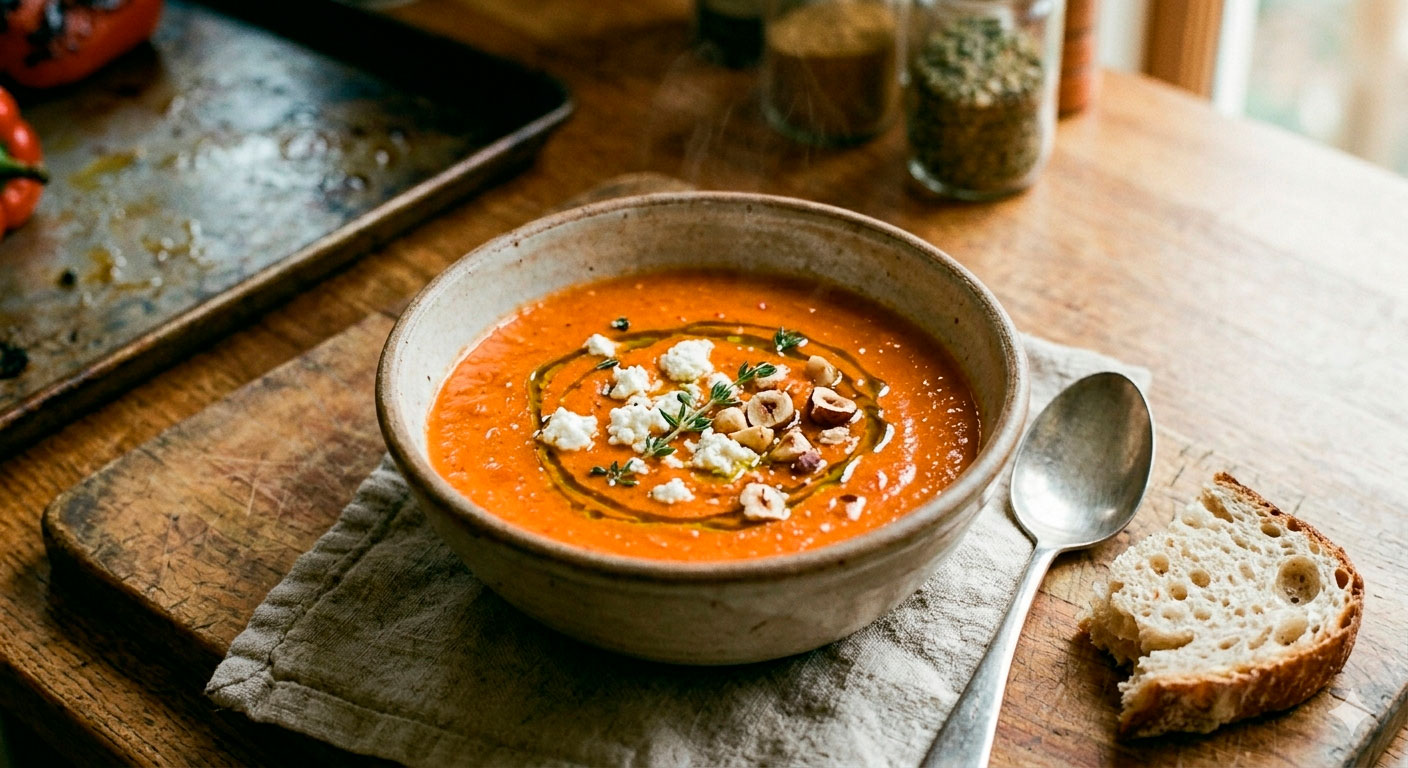
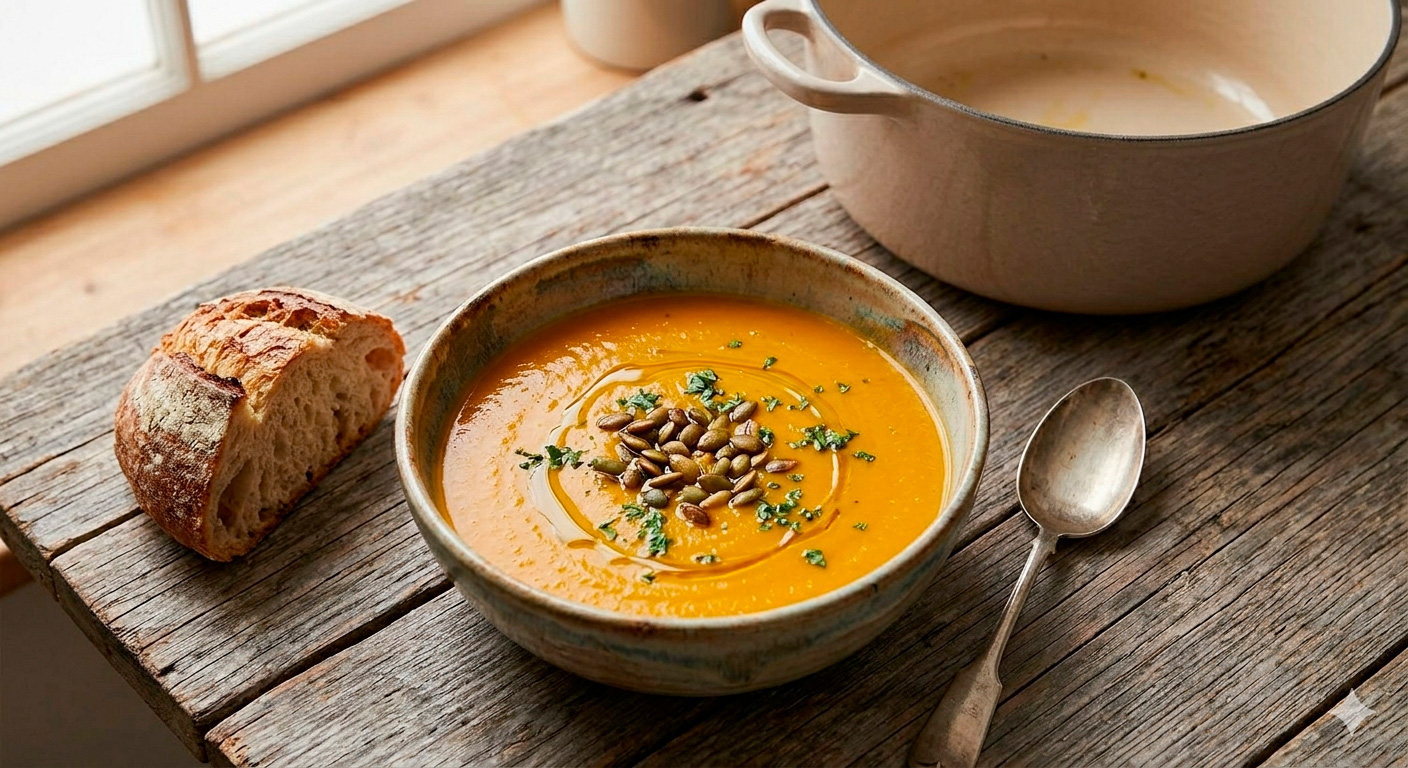
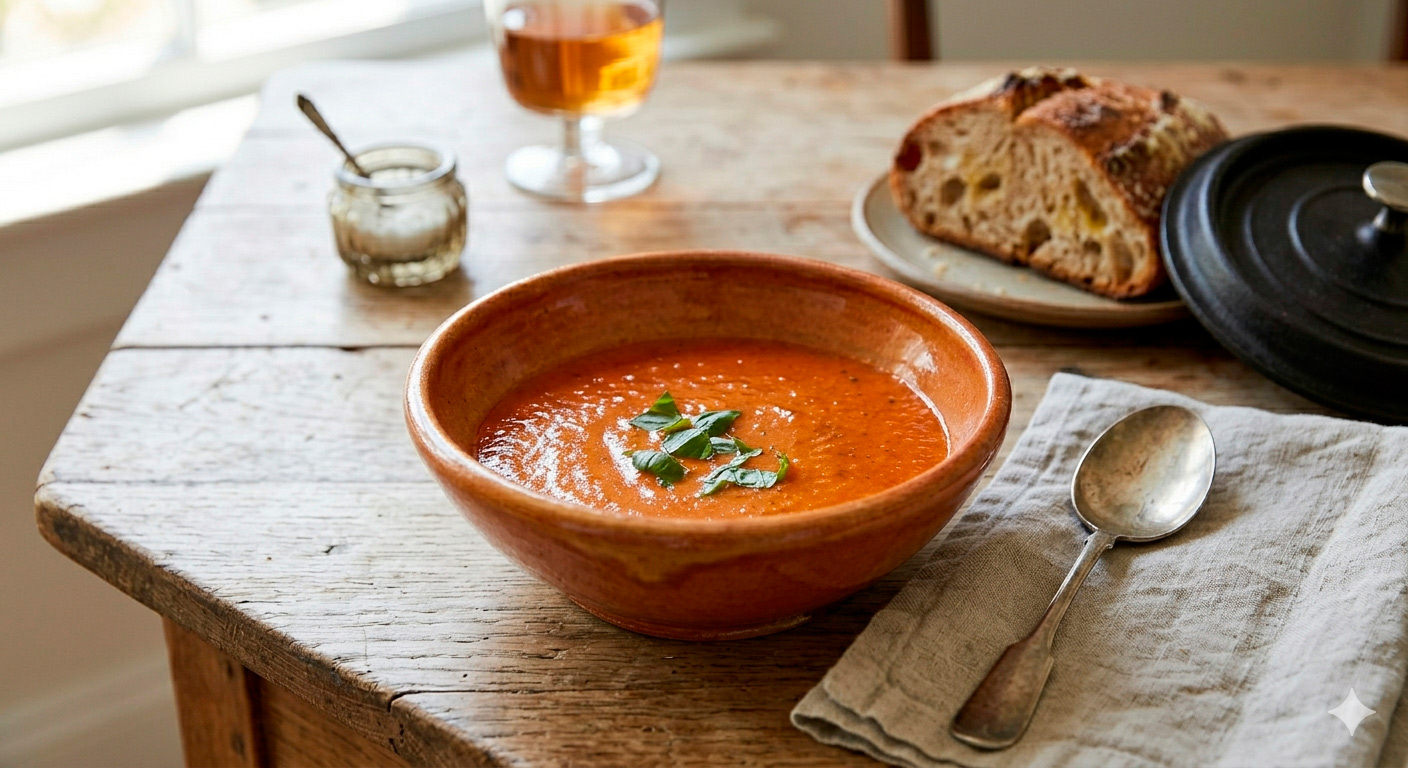
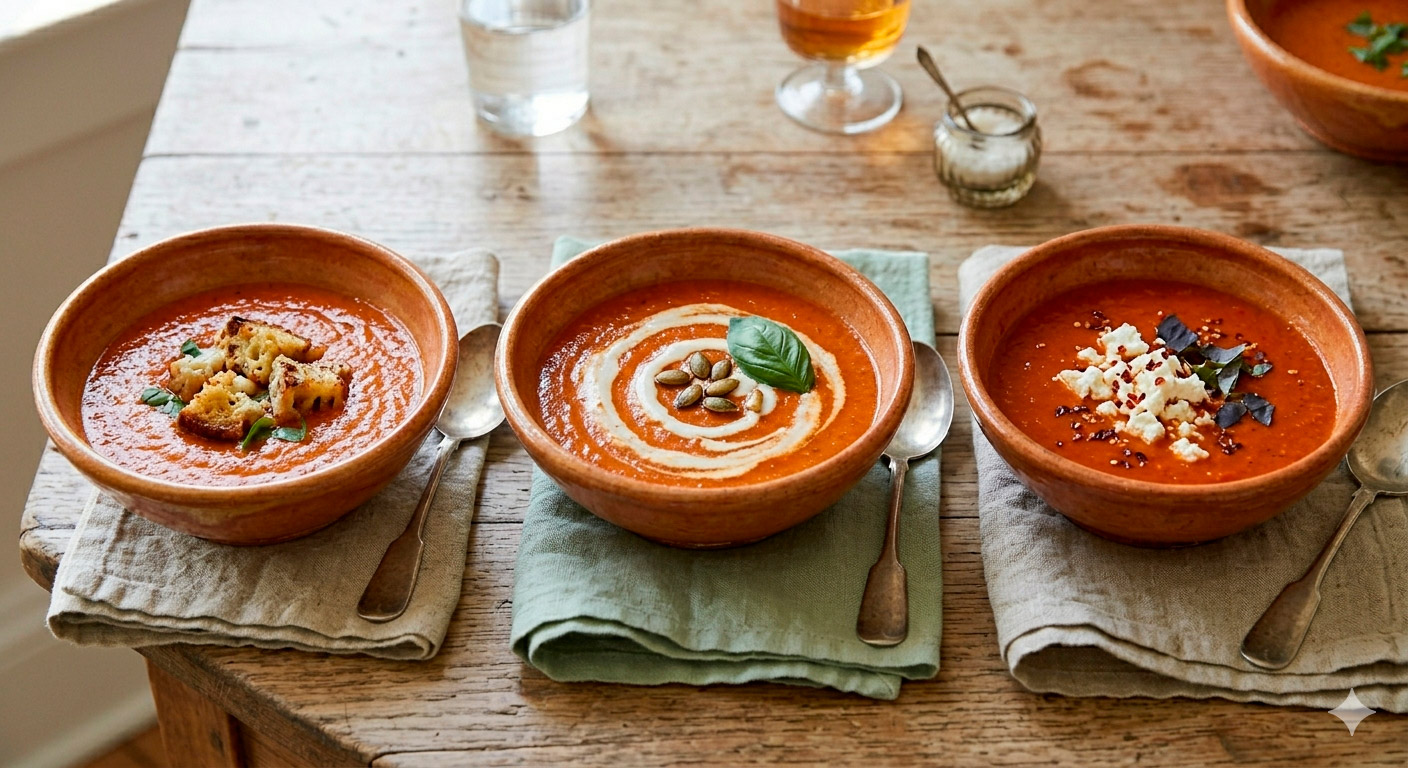
For special occasions, serve the roasted tomato and fresh basil irresistible soup in small porcelain or artisanal ceramic bowls, accompanied by sourdough bread croutons toasted with olive oil, a drizzle of sour cream on top, a few fresh basil leaves, and a twist of freshly ground black pepper. This simple and elegant plating transforms an everyday dinner into a memorable feast.
Variations and Substitutions for Roasted Tomato and Fresh Basil Soup
The pure vegan version: Omit the heavy cream and substitute it with unsweetened coconut cream or with a small potato cut into cubes that you roast along with the other vegetables; when blended, the potato starch provides the same silkiness without altering the primary flavor. This version also complies with dairy-free or gluten-free diets.
Spiced Mediterranean variant: Add a teaspoon of dried oregano and a pinch of dried red chili flakes to the baking sheet before roasting. This gives a robust and spicy character, reminiscent of the rustic sauces of southern Italy or Roman arrabiata, without losing the essence of roasted tomato soup.
Soup with a touch of goat cheese: Instead of incorporating cream at the end, crumble 15 grams of fresh goat cheese over each individual plate just before serving. The heat of the soup will partially melt the cheese, providing a lactic acidity and contrasting creaminess that elevates the dish to another level entirely.
With canned tomatoes out of season: If you are not in season for good fresh tomatoes, use two cans of whole peeled San Marzano tomatoes (400 g each). Drain the liquid, distribute the tomatoes on the baking sheet, and carry out the roasting process the same way. The result will still be far superior to direct boiling, thanks to dry heat caramelization.
Frequently Asked Questions about Roasted Tomato and Fresh Basil Irresistible Soup
Can roasted tomato and fresh basil soup be frozen?
Yes, roasted tomato and fresh basil soup freezes perfectly for up to 3 months, as long as you do it without the added heavy cream. Dairy tends to separate when thawed, resulting in an unpleasant grainy texture. Freeze only the tomato, broth, and basil base in an airtight container, and add the fresh cream just when reheating over low heat, stirring constantly.
How long does roasted tomato and fresh basil soup last in the refrigerator?
Properly stored in an airtight glass container, roasted tomato and fresh basil soup stays in optimal condition for 4 to 5 days in the refrigerator. To reheat it, pour it into a saucepan over low heat and add a splash of broth if it has thickened too much due to the tomato’s natural pectin. If you notice a sour smell or see bubbles forming when opening the container, discard it without hesitation.
How many calories are in roasted tomato and fresh basil irresistible soup?
Each serving of this roasted tomato and fresh basil soup provides approximately 185 kcal, making it an extremely light option for a starter or dinner. Its high nutrient density —especially vitamin C (46% of the daily value) and antioxidant lycopene— make it ideal for mindful eating, without sacrificing flavor or satisfaction at all.
Can roasted tomato soup be made without fresh tomatoes?
Completely viable. Out of season, substitute the fresh tomatoes with two cans of whole peeled San Marzano tomatoes (800 g total). Drain the liquid from the cans, distribute the tomatoes on the baking sheet along with the onion and garlic, and carry out the roasting process exactly the same as with fresh tomatoes. Oven caramelization will elevate the quality far above any version boiled directly in a pot.
What is the best way to serve roasted tomato and fresh basil soup?
Roasted tomato and fresh basil irresistible soup looks splendid in rustic ceramic bowls or deep porcelain bowls. It is classically accompanied by sourdough bread or country bread croutons toasted with olive oil, a drizzle of sour cream on the surface, and a few fresh basil leaves as garnish. For pairing, a fruity white wine with medium acidity —Albariño, Sauvignon Blanc, or Vermentino— perfectly complements the sweet and herbal nuances of the soup.
Reference sources and resources
For more information on food safety and nutrition, consult WHO healthy diet guides.
Regarding the nutritional value of ingredients, you can consult The Nutrition Source from Harvard T.H. Chan School of Public Health.
Information on food composition available at the database of the National Institute of Public Health of Mexico.
Consult our liability policy and legal notice before making decisions about your diet based on this content.